
Bazooka - Original
Bazooka Original bubble gum review: the penny-a-stick Brooklyn classic with a name traced back to a plumber's shop in Arkansas, and a one-eyed cartoon mascot created by the guy who drew dirty comics.
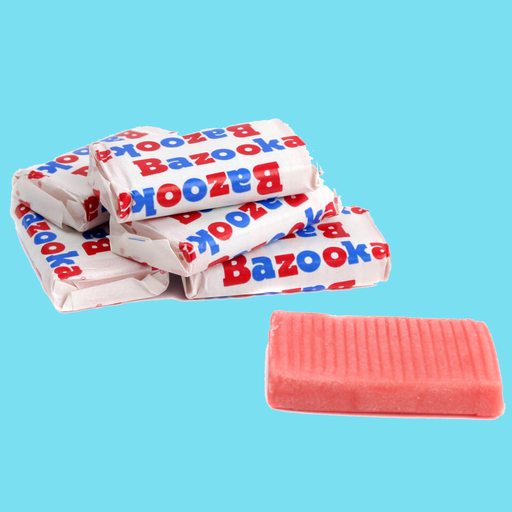
- 😋 Taste 3.8
- ⏱️ Flavor Duration 3.2
- 🫧 Bubble Size 3.0
- 👅 Texture 4.2
Bazooka Gum: Background & Overview
Bazooka Original is an American bubble gum made by Bazooka Candy Brands, launched in 1947 in Brooklyn, New York. It’s a firm, classic chew with that signature pink bubble gum flavor: the one generations of American kids grew up on. It comes in small individually-wrapped pieces, and every wrapper includes a miniature Bazooka Joe comic strip, a tradition that’s been running since 1953 and has generated over 1,535 different strips.
You can find it at most US candy shops and online. It’s cheap, everywhere, and it tastes exactly like you remember. That’s either a feature or a limitation depending on what you’re after.
A Brief, Weird, History of Bazooka Gum
Bazooka launched just after World War II, in 1947, by the Topps Company of Brooklyn. The timing was intentional: sugar rationing had lifted, Americans were in a celebratory mood, and a penny-a-stick bubble gum in red, white, and blue packaging was exactly right for the moment.
The name, though, is where it gets interesting.
The bazooka weapon is a shoulder-fired rocket launcher that became one of the defining images of the war and was named after a homemade musical instrument invented by a comedian from Van Buren, Arkansas, named Bob Burns. Burns built his “bazooka” in the back of Hayman’s Plumbing Shop: two interconnecting gas pipes, a whiskey funnel, and a trombone-like mouthpiece. He blew into it, it made a sound like, in his words, a wounded moose, and he loved it. He copyrighted the word in 1920. When Army engineers needed a nickname for their new rocket launcher in WWII, the resemblance in shape was obvious, and the name stuck. (Encyclopedia of Arkansas)
So, an Arkansas plumber’s shop instrument gets named “bazooka” and the WWII rocket launcher borrows the name. Then, a Brooklyn candy company names their gum after the weapon. That’s the lineage. Three totally unrelated things sharing the same cool sounding name.
Topps itself was not originally a candy company. They started in tobacco, selling cigarette accessories, and pivoted to confectionery after the war when they saw where the market was heading. Gum was an early move; trading cards came later. Bazooka was their foothold in the new American candy economy.
The gum launched with a penny price and patriotic packaging. Its first mascot, introduced in 1949, was “Bazooka the Atom Bubble Boy,” a character so perfectly of its atomic-age moment. Two years later, they replaced him with someone much more durable (Bazooka Joe)
Bazooka Joe and the Comics
In 1953, Topps changed everything about Bazooka’s packaging by adding a tiny comic strip wrapped around each piece of gum. The strip featured a new character named Bazooka Joe, a wisecracking kid with a black eyepatch. Joe’s gang included his younger brother Pesty (in a cowboy sombrero), Mort (who always had his turtleneck pulled up over his mouth, forever), Hungry Herman, Jane, Tuffy, and a mutt named Walkie Talkie. Each strip ended with a fortune-cookie-style prediction and a small advertisement for some piece of kitschy mail-order merchandise you could get by saving up your comics.
The eyepatch deserves an explanation. According to gum historians, Joe’s patch was a deliberate parody of the Hathaway Shirt Man, which is a famous 1951 advertising campaign by David Ogilvy that featured a distinguished gentleman wearing an eyepatch in various sophisticated situations. It ran in The New Yorker and became one of the iconic Madison Avenue campaigns of the century. Topps took that cultural symbol and put it on a wisecracking kid from Brooklyn. (Straight Dope)
The artist behind the original strips was Wesley Morse, a cartoonist recruited by Woody Gelman and Ben Solomon, Topps’ heads of product development. What Topps may or may not have known at the time: Morse had previously been one of the more prolific creators of “Tijuana Bibles” (the underground pornographic comics that were a staple of 20th-century American counterculture). Art Spiegelman, who later won the Pulitzer Prize for Maus and worked at Topps himself for a time, wrote about recognizing Morse’s distinctive style in several of those earlier works. The man who drew America’s most wholesome kids’ candy comic had quite a portfolio.
The comics ran worldwide, translated into local languages for dozens of markets. In Israel, they were printed in Hebrew. In Canada, bilingual (English/French) depending on the city. In Spain, the gum was sold as “Chicle Bazoka” (one “o”) with the slogan “Chicle bazoka, siempre en la boca”, meaning “Bazooka gum, always in the mouth.” The Bazooka Joe comic became one of the most recognized American advertising characters of the 20th century through sheer global saturation.
From 1967 to 1990, the strips were written primarily by Jay Lynch, a legend of the underground comix movement and a peer of Robert Crumb. In 1983, Howard Cruse was hired to redesign Joe and Mort as teenagers and introduce a new cast. The Topps creative director who commissioned this work, Len Brown, had a habit of hiring notable underground cartoonists for Bazooka Joe, because apparently a gum comic for children was exactly where underground comics talent landed in the early ’80s. (Wikipedia)
By the end of Morse’s original run, there were over 1,535 distinct comic-strip wrappers. That’s a staggering number. Some collectors have spent decades trying to find them all. The Bubble Bunch probably has ~30 of them, and we are still waiting for one that makes us actually laugh, but that’s ok.
In 2012, Topps made one of the more controversial candy decisions of the decade: they dropped the comics. The new wrappers had brain teasers and QR codes. What?! The backlash was immediate and vocal. By 2019, the comics were back in a Throwback pack. The lesson was learned.
In 2022, Bazooka celebrated its 75th anniversary with a 16-minute documentary. That same year, Fanatics acquired Topps; in 2023, Apax Partners then bought Bazooka Candy Brands as a standalone company, separating it from Topps entirely. Bazooka Joe has now outlasted two ownership changes.
The comics keep evolving. In 2024, Bazooka launched a crossover series with DC Comics, putting Bazooka Joe alongside Superman, Batman, Wonder Woman, and the Flash. In 2025, a limited-edition sports series dropped featuring Jason Kelce, Freddie Freeman, Dak Prescott, CC Sabathia, and others. The 1,535-strip mountain just keeps growing.
Bazooka Ads
Bazooka’s TV advertising leaned into exactly what made the gum appealing: it was cheap, it was fun, and it was American. The Saturday-morning cartoon block was prime territory for a penny candy brand. Here’s a classic spot from the 80s:
Our Bazooka Original Review
Something happens to people when they chew Bazooka. The Bubble Bunch felt it: one tester declared it flat-out the best gum out there, gave it 5 out of 5 on taste, and didn’t look back. Another just wrote “Cool.” A third went philosophical: “takes me back to the old days.” Nobody wrote more than a sentence. Bazooka Original doesn’t need much explaining.
Four testers tried it. Two found the texture just right; one called it too hard. The classic Bazooka firmness is a real thing — it’s noticeably chewier and stiffer than modern soft gums, which is part of the appeal for some and a barrier for others. Taste scores came in at 5, 4, 3, 3, which reflects an honest truth: Bazooka is a nostalgia play first and a technical gum second. If it doesn’t trigger a memory for you, it’s just a firm pink chew.
The bubbles were smaller than you’d hope. Three of four testers got ping pong to tennis ball size; one got nothing but maybe that was a skill issue. That’s on the modest side for a bubble gum, and the Pros/Cons bear it out: “bubbles not as big as we expected.” If you’re going into Bazooka looking for max bubble performance, shop elsewhere.
The flavor also doesn’t stay. Classic bubble gum taste, bold and immediate, gone in a few minutes. That’s always been Bazooka’s reality.
But here’s the thing: none of that changes what Bazooka is. It’s the gum that’s been in American pockets since 1947. It’s a penny-a-stick Brooklyn original named after a weapon named after a plumber’s pipe instrument played by an Arkansas comedian on the radio. It comes with a tiny comic drawn in a tradition that passed through underground artists, Pulitzer Prize winners, and now DC superheroes. If you want to know what bubble gum is supposed to taste like and where it all comes from, this is a good place to start. Check out our best bubble gum rankings to see where it stacks up against the competition.
Visitor Reviews
Reader ratings and comments are coming in a later phase. Soon you'll be able to score this gum yourself and tell us what you think.
In a Nutshell
What we like 👍
What we don't like 👎
The Bubble Bunch has a soft spot for this one. "Best gum out there," said one tester, and more than a few of us agreed that a piece of Bazooka takes you straight back to the old days. That makes sense: Bazooka is the original, launched by Topps in Brooklyn all the way back in 1947 and named after a goofy homemade instrument. It is the classic firm, old-school chew, and every wrapper still hides a tiny Bazooka Joe comic, a tradition going since 1953. Pure nostalgia in pink.